




 Red Brick calculation program





Blog
What is an I-beam? What is it used for? How to choose one? | AY Contento
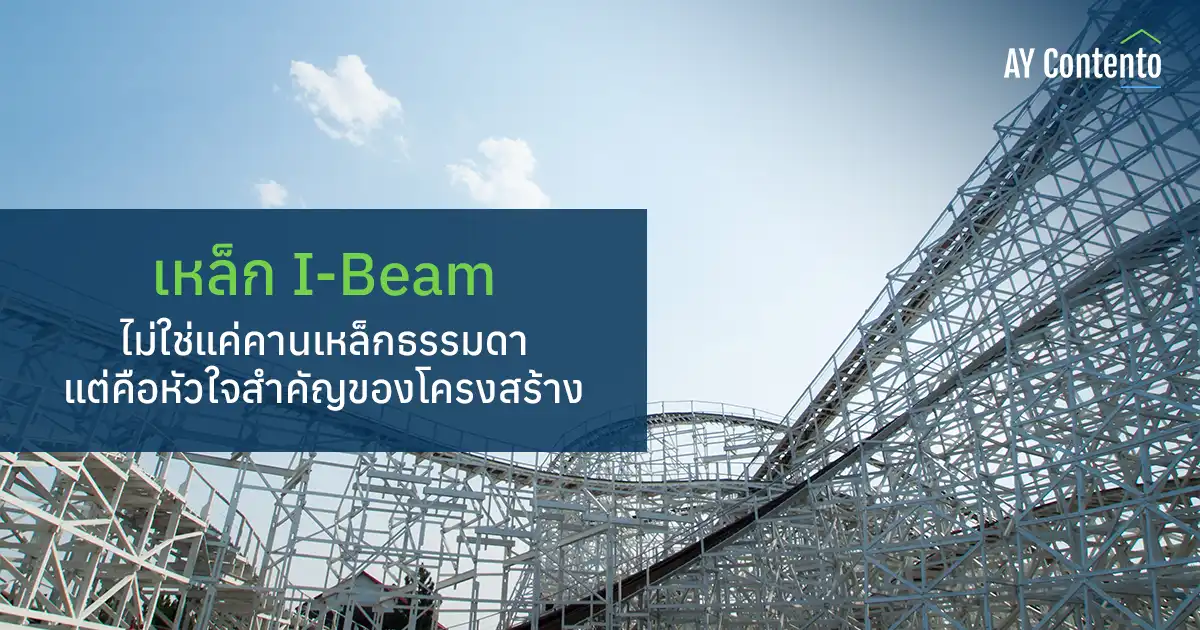
I-Beam steel It is a construction material behind large structures worldwide, from skyscrapers and bridges to crane rails in industrial plants. With its "I" shaped cross-section, this type of steel can efficiently support enormous loads and differs significantly from H-beams in its application.
If you're planning a construction project, need to install crane rails in a factory, or want to understand the difference between I-Beams and H-Beams, this article compiles comprehensive information, from definitions and advantages to applications, standard size charts, and how to choose the right one for your project.
Table of Contents
What is an I-beam?
I-Beam steel I-beams are hot-rolled steel sections with an "I" shape, consisting of two horizontal plates called flanges connected by a vertical plate (web). Their distinctive feature is the uneven thickness of the flanges—thicker at the base and thinner at the ends (tapered flange). This uneven thickness provides excellent localized bending and shear resistance, particularly useful in crane rail applications where conventional H-beams cannot replace them.

Structure and components of I-Beam steel.
To understand why I-Beams are exceptionally strong, you need to know about their three components:
- Flange: The horizontal steel plates above and below act to resist bending moment. The flanges of the I-beam are sloped — thicker at the base and tapering towards the edges, unlike... H-Beam With wings of uniform thickness throughout.
- Waist (Web): The vertical steel plate in the middle of the fuselage serves to resist shear force and connects the two wings together.
- Curved corner (Fillet/Radius): The curved shape at the joint between the wings and the waist helps distribute stress and reduce the risk of structural cracking when subjected to repeated impacts.
This type of structure is considered a clever engineering design because the materials are positioned to withstand the greatest stress, resulting in maximum strength using the least amount of steel.
Advantages of I-Beam steel
I-beams have five main advantages that have made them popular in the construction industry for a long time:
1
High strength
The I-shaped cross-section allows it to support enormous loads over long distances, making it ideal for large-scale construction projects requiring maximum stability.
2
versatile
Available in various sizes and thicknesses, from small residential building projects to large industrial plant structures.
3
Good value for the price.
When comparing the weight-to-load capacity ratio, I-beams offer high performance at a reasonable price.
4
Durable and long-lasting.
Steel is naturally resistant to corrosion and fire, making structures long-lasting and reliable.
5
Environmentally friendly
Steel can be melted down and recycled (100%), promoting sustainable construction.
The use of I-beams in construction.
I-beams are used in a wide variety of construction applications, including:
- Building construction: Used as load-bearing beams for floors, roofs, and walls of all types of buildings, from residential to commercial buildings. Can be used in conjunction with...Wire mesh reinforcement.To increase the structural strength.
- bridge: It is used as the main structural component of road and railway bridges, safely supporting the weight of vehicles and pedestrians.
- Industrial structure: Used in warehouses, factories, and manufacturing facilities to support heavy machinery and equipment with high vibration levels.
- Crane runway: This is a special feature of I-Beams. The wheels of factory cranes are designed to run on tapered flanges, making them more resistant to the compressive forces from the crane wheels than other types of steel.
- Shipbuilding: It is used to reinforce the structure of ship hulls and marine vessels, and effectively absorbs vibrations from engines and waves.
What are the differences between I-beams and H-beams?
One of the most frequently asked questions in the construction industry is: should I-Beam or H-Beam be chosen? The comparison table below will help you make the decision easier:
| feature | I-Beam steel | H-Beam steel |
|---|---|---|
| Wing shape | Sloping — Thick at the base, thin at the tip (Tapered) | Uniform thickness along the entire length (Parallel) |
| Wing edge | Rounded Edges | The scene is cut almost perfectly straight. |
| Wing span | Narrower | Wider than (approximately the height). |
| Bending strength | Excellent | good |
| Ability to withstand compressive force (in all directions) | moderate | Excellent |
| Primary usage | Crane rails, long span beams | Building columns, general beams. |
In short: If desired. pole → H-Beam | If needed Crane rails → I-Beam
Standard sizes of I-beam steel commonly used in Thailand.
The table below lists the standard sizes and approximate weights of I-Beams sold in Thailand:
| Dimensions H × B × t₁ × t₂ (mm) | Weight (kg/6m length) |
|---|---|
| 150 × 75 × 5.5 × 9.5 | 102.6 |
| 200 × 100 × 7 × 10 | 156.0 |
| 200 × 150 × 9 × 16 | 302.4 |
| 250 × 125 × 7.5 × 12.5 | 229.8 |
| 300 × 150 × 8 × 13 | 282.0 |
| 300 × 150 × 10 × 18.5 | 432.0 |
| 350 × 150 × 9 × 15 | 351.0 |
| 350 × 150 × 12 × 24 | 582.0 |
| 400 × 150 × 10 × 18 | 432.0 |
| 450 × 175 × 11 × 20 | 550.2 |
| 450 × 175 × 13 × 26 | 720.0 |
Note: H = cross-sectional height, B = flange width, t₁ = waist thickness, t₂ = average flange thickness.
How to choose the right I-beam for your project.
Selecting the correct I-beam requires considering four main factors:
- Load capacity requirements: Calculate the total weight the beam must support, including both dead load and live load from machinery or vehicles.
- Length (Span): The distance between supports is very important. Long span beams require a larger cross-section to control deflection.
- Material grade: I-beams are typically manufactured from SS400 steel for general applications and SS540 for applications requiring exceptionally high strength. Different grades offer different tensile strengths.
- Budget and order quantity: Pricing depends on size, thickness, grade, and order quantity. Large projects often receive special pricing when ordering in bulk.
Expert advice: Structural engineers should be responsible for specifying the correct I-beam specifications according to engineering standards, especially for crane runways, which must have high safety standards and comply with regulations.Structural steel industryinternational
Calculation
I-beams are indispensable structural steel in modern construction, especially for projects requiring high load-bearing capacity over long periods. Important points to remember:
- The "I" shaped cross-section has excellent resistance to bending and shear forces.
- Tapered flanges are a clear distinguishing feature of H-beams.
- Ideal for crane rails, long span beams, and heavy industrial structures.
- Standard sizes range from 150×75 to 450×175 mm, depending on the weight and range it needs to support.
- The grade and size should be selected according to the engineer's recommendations.
See examples of real-world projects that use structural steel at:AY Contento's Projects page. Or, you can have experts help you select the right I-Beam specifications for your project. Contact the AY Contento team. Sure thing. We have all types of steel available and offer nationwide delivery.
Frequently Asked Questions (FAQ)
What is an I-beam?
I-beams are hot-rolled steel sections with an I-shaped cross-section, consisting of two flanges and one web. The flanges are sloped—thicker at the base and thinner at the ends—giving them excellent bending and shear strength. They are commonly used for crane rails, long-span structural beams, and heavy industrial applications.
How do I-beams differ from H-beams?
The main difference lies in the flange shape. I-beams have tapered flanges—thicker at the base, thinner at the tip, and with rounded edges—ideal for crane rails. H-beams, on the other hand, have flanges of uniform thickness along their length (parallel) with square edges, suitable for building columns. A simple way to tell the difference is: if the flange thickness is uneven and the edges are rounded, it's an I-beam.
Can H-beams be used instead of I-beams for crane tracks?
It is not recommended because factory crane wheels are designed specifically to run on the sloping flanges of I-beams. Using H-beams with flat flanges will result in suboptimal load-bearing capacity, premature flange damage, and increased risk of accidents during operation.
What are the different sizes of I-beams?
Popular sizes in Thailand range from 150x75 mm to 450x175 mm. The weight per 6-meter length is approximately 102–720 kg. The size selection depends on the weight capacity, length, and engineering requirements of the project.
How is the price of I-Beam steel calculated?
I-beam steel prices are calculated per kilogram or per piece, depending on size, steel grade, and order quantity. Large projects or high-volume orders often receive special pricing. Contact AY Contento to get a quote tailored to your needs.
Share:


