




 Red Brick calculation program





Blog
What is lightweight brick used for? Which type of construction work is suitable for?

The answer in summary: Lightweight concrete blocks Standard size is 20 x 60 cm, but three thicknesses are available: 7.5 cm (suitable for non-load-bearing interior walls), 10 cm (suitable for load-bearing exterior walls), and 15 cm (suitable for applications requiring maximum strength). The size selection should consider the type of project, budget, and thermal insulation requirements.
Lightweight bricks (Autoclaved Aerated Concrete AAC (Aluminum Acrylic) is becoming increasingly popular in the Thai construction industry due to its weight being 3-4 times lighter than traditional bricks, saving construction time, and its excellent heat insulation properties.
But the most important thing for craftsmen and contractors to know is how to choose. Lightweight brick size Choose the right type of wall for each project, because the wrong choice can affect wall strength, increase the budget, or make the house too hot.
Table of Contents
What are the standard sizes of lightweight concrete blocks?
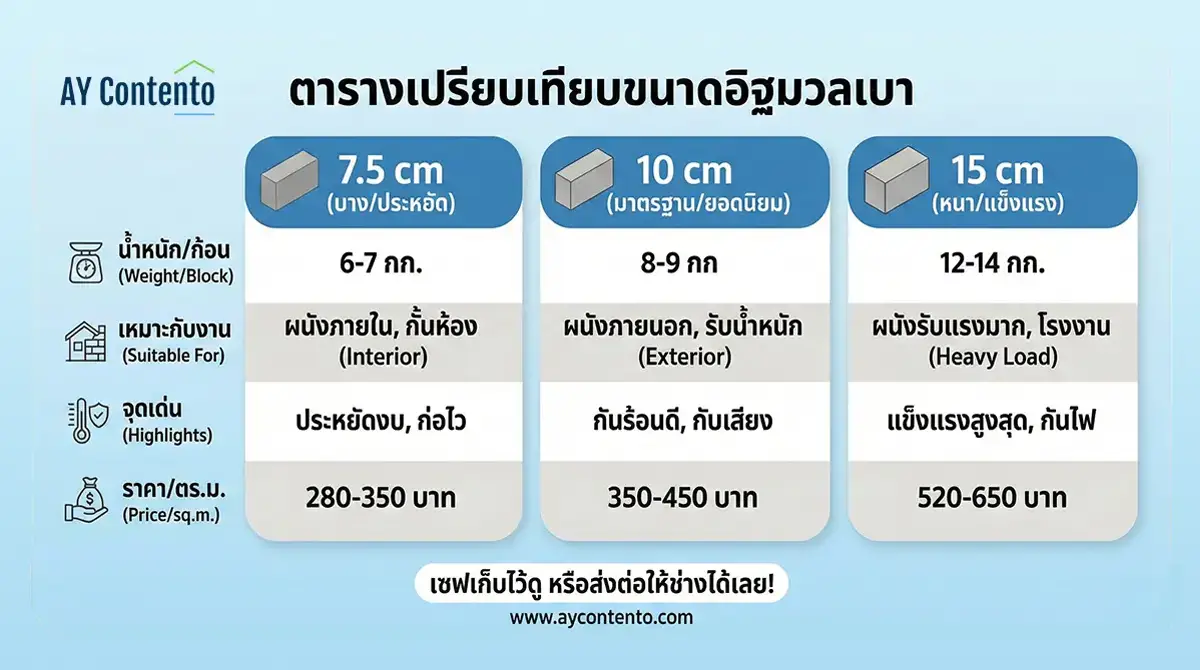
Lightweight concrete blocks in Thailand have standard sizes. Width × Length = 20 × 60 centimeters Essentially, they are made of the same material, but the thickness varies, and each size has its own advantages and applications.
Comparison table of the sizes of three types of lightweight concrete blocks.
Size | Weight/block | Suitable for the job. | Price per square meter (approximate) |
6-7 kg. | Interior walls, partition walls, non-load-bearing walls | 280-350 baht | |
8-9 kg. | Exterior wall, load-bearing wall, house wall. | 350-450 baht | |
12-14 kg. | Load-bearing walls, retaining walls, factories. | 520-650 baht |
Not sure how many you need? Use... Lightweight brick calculation program Ours is free! Click here
Details of each size of lightweight concrete block.
1. Lightweight brick, 7.5 cm thick. Lightweight and economical.
strength:
- The cheapest option, perfect for those on a budget.
- Lightest and easiest to lift and move.
- Saves space because it's thinner.
- Faster construction, reduced labor costs for builders.
weakness:
- It provides less heat insulation than the thicker version.
- It provides less sound insulation.
- Not suitable for load-bearing walls.
Suitable for the job:
- Interior partition walls
- bathroom wall
- Light cushion wall
- Applications that do not require special heat insulation.
2. Lightweight bricks, 10 cm thick. – Popular size
This is the most popular size used in Thailand. Because of the balance between price, strength, and heat insulation.
strength:
- The price is reasonable and the performance is worth the money.
- Provides good heat insulation and actually reduces air conditioning costs.
- Strong enough for a load-bearing wall.
- Easy to find, available in every store.
weakness:
- More expensive than the 7.5 cm size.
- Slightly heavier.
Suitable for the job:
- exterior walls of the house
- General load-bearing walls
- Commercial building walls
- House walls that need good heat insulation.
3. Lightweight bricks, 15 cm thick. – Strongest
strength:
- Strongest; can bear the most weight.
- Excellent heat insulation.
- Provides the best sound insulation.
- Impact resistant
weakness:
- Most expensive
- The worst
- It takes up more space.
Suitable for the job:
- Load-bearing wall
- retaining wall
- factory walls
- High-rise building walls
- Applications requiring maximum protection against noise or heat.
How to Choose the Right Lightweight Concrete Brick Size for Your Project (7 Factors)
1. Consider the type of job.
Interior walls: Use 7.5 cm; it's budget-friendly.
Exterior walls: Using 10 cm is good for heat insulation.
Load-bearing walls: Use 10-15 cm, depending on the weight.
2. Consider strength.
If the wall needs to support the weight of the roof, a second floor, or install heavy equipment, choose a thickness of 10 cm or more.
3. Consider the thermal insulation requirements.
U-Value (the lower the better):
- 7.5 cm. = 1.4-1.6 W/m²K
- 10 cm. = 1.1-1.3 W/m²K (Air conditioning cost saving 15-20%)
- 15 cm. = 0.8-1.0 W/m²K (Saves on air conditioning costs 25-30%)
4. Estimate the budget.
Example calculation: If you need to build a wall of 100 square meters...
- 7.5 cm = 28,000-35,000 baht
- 10 cm = 35,000-45,000 baht
- 15 cm = 52,000-65,000 baht
5. Areas that have...
If space is limited, thin bricks (7.5 cm) can save more space, especially in small rooms.
6. The need for soundproofing.
For effective soundproofing (e.g., bedrooms, studios), choose a thickness of 10 cm or more, as thicker material provides better sound insulation.
7. Geographic location
- Southern region (hot and humid): 10 cm or more should be used.
- Northern region (cool weather): 7.5 cm may be acceptable.
- Bangkok (very hot): 10 cm recommended.
Frequently Asked Questions (FAQ)
There's no single best size for every job; it depends on the application. But for typical home use, 10 cm is recommended because it's the most balanced.
It offers better protection than traditional bricks, but is smaller than 10 and 15 cm sizes. It's suitable for interior walls that aren't exposed to direct sunlight.
Yes, but it's not recommended because it provides less heat insulation, which may make the house hotter, and it's more prone to cracking.
If the wall doesn't need to bear much weight, 10 cm is recommended as it's more economical. However, if it's a load-bearing wall or you need maximum sound/heat insulation, 15 cm should be used.
Yes, generally thicker bricks are stronger, but density and quality also need to be considered.
10 cm is the most popular size in Thailand, followed by 7.5 cm and 15 cm.
They differ, especially in density, weight, and strength. Choose a brand with Thai Industrial Standards (TIS) certification, such as Q-CON, THAICON, or Airblock.
Approximately 8.3 blocks per square meter for all thicknesses (because the length x height dimensions are the same).
Lightweight concrete blocks vs. clay bricks: What are the differences?
| Compare | Lightweight concrete blocks | Red brick |
| weight | 6-14 kg/block (3-4 times lighter) | 2.5-3.5 kg/block |
| Heat protection | Very good (reduces air conditioning costs by 20-30%) | moderate |
| Price: | 280-650 baht/sq.m. | 180-250 baht/sq.m. |
| Construction time | Faster than 30-40% | Slower |
Summary: Which size lightweight concrete block should I choose?
Instructions for general home use:
- Interior walls: Use 7.5 cm (budget-friendly).
- Exterior walls: Use 10 cm (recommended).
- Load-bearing wall: Use 10-15 cm (depending on the weight).
The most important thing is... Don't choose based solely on price; consider practical use. Making the wrong choice may lead to future repairs or replacements, which will cost more.
And most importantly... Choose lightweight concrete blocks that meet standards. TIS From trusted brands such as Q-CON, THAICON, and Airblock, for strength and long-lasting durability.
Contact us for inquiries and orders.
For project clients or contractors requiring special project pricing, please contact:
- Phone number: 083-024-3351
- LINE: @aycon
- Website www.aycontento.com
📌 Nationwide delivery service.
📌 We have lightweight concrete blocks of all sizes and brands.
📌 Free consultation
-
 Lightweight brick, Taicon, 20 cm.
Rated 5.00 out of 5
Lightweight brick, Taicon, 20 cm.
Rated 5.00 out of 5 -
Lightweight brick, Taicon, 7 cm.
Rated 5.00 out of 5
-
THAICON lightweight brick 7.5 cm
Rated 5.00 out of 5
-
Lightweight brick, Taicon, 10 cm.
Rated 5.00 out of 5
-
Lightweight brick, Taicon, 17.5 cm.
Rated 5.00 out of 5
-
Lightweight brick, Taicon, 12.5 cm.
Rated 5.00 out of 5


Share:


